Here’s a number that surprises most business owners the first time they hear it: on average, only 2-4% of website visitors convert on their first visit. That means if 1,000 people land on your site this month, roughly 960 of them will leave without buying, enquiring, or booking anything.
The instinct is to treat this as a failure — bad targeting, weak copy, wrong audience. Sometimes that’s true. But most of the time, those 960 people simply weren’t ready yet. They were comparing options, got distracted, or needed more convincing. And once they leave, you’ve spent money getting them there and gotten nothing back.
This is exactly the problem retargeting ads solve.
What Retargeting Actually Is
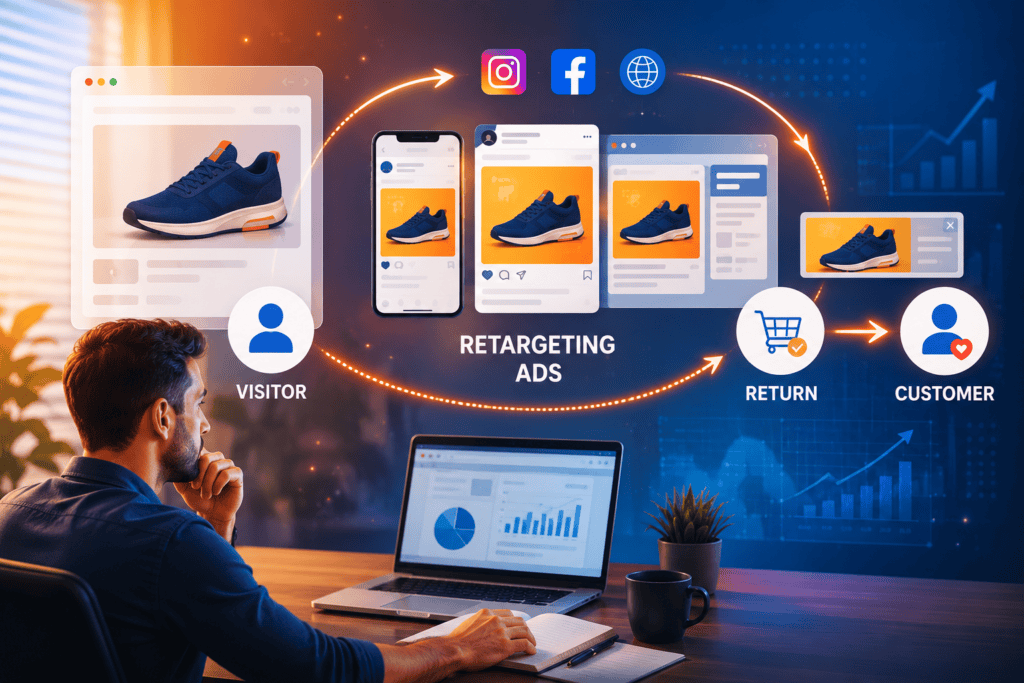
Retargeting (sometimes called remarketing) shows ads specifically to people who’ve already visited your website, viewed a product, or engaged with your business online — but didn’t take the final step. Instead of paying to reach a cold, brand-new audience again, you’re reaching people who already know who you are.
You’ve experienced this yourself. You look at a pair of shoes online, close the tab, and for the next three days that exact pair follows you across Instagram, Facebook, and random websites. That’s retargeting. Annoying when done badly, remarkably effective when done well.
Why It Works Better Than Cold Ads
A cold ad is trying to convince a stranger to trust you in the space of a few seconds. A retargeting ad is reminding someone who already showed interest to finish what they started. That’s a fundamentally easier job.
This shows up directly in the numbers. Retargeted visitors are significantly more likely to convert than first-time visitors, and click-through rates on retargeting ads typically run several times higher than standard display ads. You’re not fighting for attention from zero — you’re picking up a conversation that already began.
Common Ways Businesses Use Retargeting
Website visitor retargeting — Show ads to anyone who visited your site in the last 7, 14, or 30 days, reminding them to come back.
Cart or form abandonment retargeting — Someone added a product to cart, or started filling an enquiry form, and left. Target them specifically with a nudge, sometimes with an added incentive.
Product-specific retargeting — If someone viewed a specific product or service page, show them ads featuring that exact product, not a generic brand ad.
Past customer retargeting — Existing customers are often the easiest people to sell to again. Retarget them with related products, renewals, or upsells.
Video and social engagement retargeting — Target people who watched a portion of your video ad or engaged with your Instagram/Facebook page, even if they never visited your website.
What a Good Retargeting Campaign Needs
Retargeting isn’t just “turn on the setting and let it run.” A few things separate campaigns that actually perform from ones that quietly waste budget.
Frequency caps. If the same ad follows someone 15 times a day, it stops feeling like a reminder and starts feeling like harassment. Cap how often any one person sees your ad.
Segmented audiences. Someone who viewed your homepage for ten seconds is a very different prospect from someone who added a product to cart. Treat them differently — don’t show both groups the same generic ad.
Fresh creative. The same static ad shown for weeks stops working. Rotate your creative, and make sure the messaging evolves — sometimes it’s a reminder, sometimes it’s a discount, sometimes it’s addressing a specific objection.
A defined time window. Someone who visited your site eight months ago and never returned is probably not a warm lead anymore. Set a reasonable retargeting window — often 14 to 30 days — rather than chasing everyone indefinitely.
A clear next step. The ad should lead somewhere specific — back to the exact product, a simplified enquiry form, or a limited-time offer. Sending them back to a generic homepage wastes the second chance.
Where Retargeting Fits Into Your Bigger Marketing Picture
Retargeting isn’t a replacement for getting traffic in the first place — it’s what makes that traffic worth more. If you’re already running Google Ads, SEO, or social media campaigns to bring people to your site, retargeting is what catches the majority of visitors who don’t convert immediately and gives you another shot at turning that spend into an actual customer or lead.
It’s one of the more cost-effective parts of a marketing budget precisely because you’re targeting people who’ve already shown interest — not starting from zero.
The Bottom Line
Most businesses lose the majority of their website visitors quietly, without ever getting the chance to bring them back. Retargeting is one of the simplest ways to fix that — not by spending more to reach new people, but by making better use of the traffic you’re already paying for.
At AIMS Digital, we set up and manage retargeting campaigns as part of a complete digital marketing strategy — not as an afterthought. If your website is getting traffic but conversions still feel lower than they should be, reach out and we’ll take a look at what’s happening after people leave your site.