A shop owner asked me something honest last week. “I’ve got a limited budget. Do I put it into Google Ads, or SEO? I can’t afford to do both properly right now.” Fair question, and one nearly every small business owner eventually asks.
Here’s the thing. Most articles online either pick a side dramatically, or give you a wishy-washy “it depends” without actually helping you decide. Let’s do better than that. This isn’t about which one is “better.” It’s about which one fits where your business actually stands right now.
The Core Difference, in Plain Terms
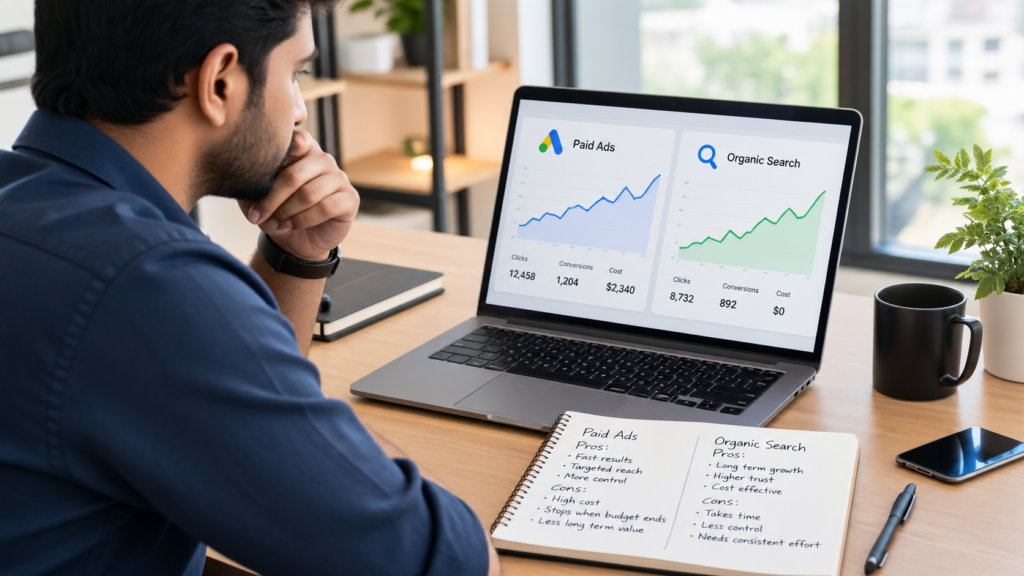
Google Ads gets you to the top of search results immediately. You choose your keywords, set your budget, and your business shows up today. The moment you stop paying, though, that visibility disappears instantly. Simple as that.
SEO works differently. You’re improving your website so it ranks organically, without paying per click. Nobody hands you the top spot. You earn it, slowly, sometimes painfully slowly. But once it works, it tends to keep working, even after you stop actively investing in it.
A useful way to think about it: Google Ads is like renting a house. SEO is like owning one.
When Google Ads Makes More Sense First
If you need customers now, not in six months, Google Ads is usually the right starting point. This applies especially if you’re launching something new, testing whether an offer actually works, or operating in a competitive market where ranking organically would realistically take 6 months or more.
Ads also give you something SEO can’t in the early days, immediate data. You’ll see exactly which keywords convert, which messaging resonates, and where your budget performs best. That data becomes genuinely useful later, even for your SEO strategy.
Typical small business ad spend runs somewhere between ₹50,000 to ₹2,50,000 a month, including management, though this varies heavily by industry and competition level. Traffic can start within hours of launching a campaign. But the moment that spend stops, so does the traffic. There’s no lingering benefit once you turn off the tap.
When SEO Makes More Sense First
If your budget is genuinely tight, or you’re playing a longer game with your business, SEO tends to be the smarter starting investment. Expect meaningful ranking improvements to take 3 to 6 months for moderately competitive terms, and sometimes 12 months or more for highly competitive ones. There’s no way to rush this timeline, no matter how much you’d like to.
However, once your content and site authority build up, the cost per lead tends to drop significantly over time, unlike ads, which keep costing you at roughly the same rate indefinitely. If you run a local service business, an e-commerce store, or a B2B company with a longer sales cycle, SEO often becomes your biggest long-term lead source.
The Honest Answer: Most Businesses Eventually Need Both
Here’s what the data across 2026 actually shows. The highest-performing small businesses don’t really debate SEO versus Google Ads as an either-or choice. They use both, strategically, at different stages.
Think of it like a bridge and a road under construction. Google Ads is the bridge, carrying traffic to your site while your SEO foundation gets built underneath. You don’t need that bridge forever, but you absolutely need it while the real infrastructure is still being laid down.
A common, sensible approach looks like this: start with Google Ads for immediate visibility and validated messaging, while simultaneously building your SEO in the background. As your organic traffic grows and starts contributing meaningfully, gradually shift more of your budget toward SEO, since it typically becomes cheaper per lead over time.
A Free Win Most Businesses Skip Entirely
Before spending a single rupee on ads, there’s one thing worth doing first regardless of your final strategy. A complete, accurate, regularly updated Google Business Profile can increase clicks to your website and direction requests by a significant margin, based on recent local SEO research. That’s free traffic, sitting there unclaimed for a lot of businesses. Spend the 45 minutes getting this right before you spend anything on paid search.
Why 2026 Changes the Calculation Slightly
Here’s something worth understanding before making your decision. AI has genuinely changed how both channels perform this year. Google increasingly displays AI-generated summaries at the top of search results for many queries, and getting featured there requires content that demonstrates real, first-hand expertise and comes from sources with strong trust signals, not generic, mass-produced content.
In other words, thin SEO content built purely around keyword stuffing performs worse than it used to. Meanwhile, genuinely helpful, well-structured content that reflects real experience is increasingly rewarded, both in traditional rankings and in these newer AI-powered results. This actually favors small businesses willing to invest in genuine, specific content over generic filler.
What You Should Actually Do
If you need leads urgently, are testing a new offer, or operate in a highly competitive space where organic ranking would take too long, start with Google Ads. If your budget is limited and you can afford patience, start with SEO, particularly local SEO if you serve a specific geographic area.
Either way, don’t treat this as a permanent, one-time decision. Revisit your mix every few months. One slow month with ads shouldn’t tempt you to abandon your organic investment entirely, and one slow month of SEO progress shouldn’t mean giving up before the compounding effects actually show up, which is usually somewhere between month 6 and month 18, not immediately.
Getting the Mix Right for Your Specific Business
Honestly, the right answer depends heavily on your specific market, your current website’s authority, your competition, and how quickly you genuinely need results. That’s not a cop-out answer, it’s just the reality of how these two channels actually behave differently for different businesses.
At AIMS Digital, this is exactly the kind of assessment we do before recommending anything. We look at your website, your competition, your budget, and your timeline together, rather than pushing a one-size-fits-all package. If you’re stuck deciding where to put your next marketing rupee, get in touch with our team and we’ll walk you through what actually makes sense for your specific business, not a generic recommendation.