
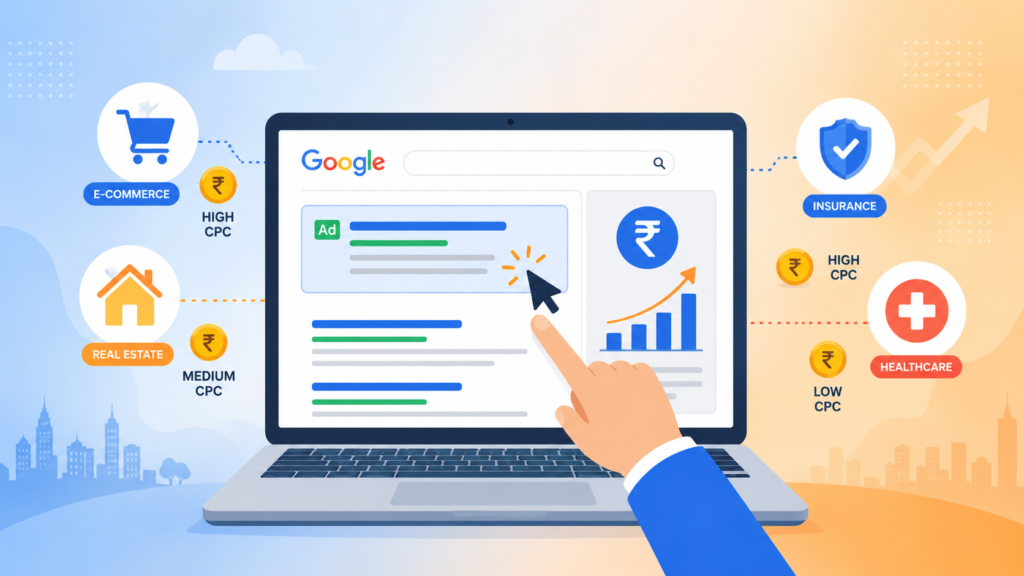
Every few weeks, a client sends us a screenshot of their Google Ads dashboard. There’s one question attached: “Is this CPC too high?” Honestly, there’s rarely a straight yes or no answer. A ₹40 click could be a steal for one business. For another, it could be a total waste of money. It all comes down to what industry you’re in.
So let’s break this down properly. No random numbers thrown at you and called “research.”
First, What Is CPC Anyway?
Cost-Per-Click is simply what you pay each time someone clicks your Google ad. Nothing complicated there. What trips people up is assuming it’s a fixed rate, like a menu price. It isn’t.
Every time someone types a search query, Google runs a live auction behind the scenes. Your CPC gets decided fresh, based on things like:
- How many other advertisers want that same keyword
- Your Quality Score (basically, how relevant your ad and landing page are)
- What you’ve set as your maximum bid
- How strong the searcher’s intent is — someone typing “buy” is worth more to Google than someone just window-shopping
Here’s the part most business owners get wrong. A high CPC doesn’t automatically mean you’re overpaying. A low CPC doesn’t automatically mean you’re winning. What matters is whether those clicks actually turn into customers.
Why the Same Click Costs Different Amounts
Think about it from Google’s side for a second. Advertisers bid based on what a customer is ultimately worth to them.
An insurance company might make lakhs off one policyholder over several years. So they’ll happily pay ₹300 for a click if there’s a decent chance it converts. A local bakery is looking at maybe a few hundred rupees of value from one order. Nobody there is fighting over ₹300 clicks.
That’s really the whole story behind CPC variation.
Where Different Industries Land
Here’s a rough way to think about it:
Cheaper clicks usually show up in local services, restaurants, general retail, and travel. Competition per keyword tends to be lower, and people decide fast.
Mid-range pricing is common in e-commerce, education, and healthcare. Costs can still climb quickly once you’re bidding on competitive, high-intent searches.
The expensive end belongs to insurance, lending and BFSI, legal services, and real estate. One converted lead can be worth so much here that businesses pay a premium just to be in the running.
How India Compares Globally
If you’re comparing notes with someone advertising in the US or UK, here’s something worth knowing: Indian CPCs tend to run 60-80% lower for equivalent keywords. So while it might feel expensive when you’re staring at your own dashboard, your money is genuinely stretching further here than it would almost anywhere in the West.
A quick honest disclaimer. If you go looking around online for “average CPC in India,” you’ll find wildly different numbers from different sources. Some quote city averages. Some quote specific keyword categories. A lot of it is outdated or just inconsistent with each other. Take any number you read — including the ranges above — as a rough compass, not gospel. The only number that really matters is the one sitting in your own Google Ads account.
Stop Chasing a Low CPC. Chase This Instead.
Here’s a mistake we see a lot. Business owners obsess over getting their CPC down. But the number that actually decides whether a campaign is working is cost per lead.
The math is simple:
Cost Per Lead = CPC ÷ Conversion Rate
Say your CPC is ₹100. Your landing page converts 10% of visitors. That’s a ₹1,000 cost per lead. Now say another business has a cheaper-looking ₹20 CPC. But their landing page only converts 1% of the time. Their cost per lead is ₹2,000 — double, despite the “cheaper” click.
This is exactly why two businesses in the same industry can look at completely different CPCs and both be doing just fine. Or both be in trouble.
So How Do You Actually Find Your Benchmark?
Forget generic industry blog posts, including this one, honestly. Here’s what actually works:
- Open Google’s Keyword Planner and check bid estimates for your specific keywords and city. Not a national average pulled from somewhere else.
- If you’ve run ads before, your own account history is more useful than anyone else’s benchmark.
- Work backward from your margins. Figure out your maximum viable CPC — how much can a lead cost before it stops being profitable for you?
- Set a realistic starting budget. Low-CPC local businesses can often see something happening from ₹10,000-15,000 a month. High-CPC industries like finance or real estate usually need more, just to collect enough data to optimize properly.
Bottom Line
There isn’t a universal “good” CPC in India. There’s only a good CPC for your business, your margins, and your industry. Everything else is noise.
If you’re staring at your Ads dashboard right now wondering whether your numbers are actually healthy, that’s a conversation worth having. No jargon. Just a straight look at what those numbers mean for your business.
Curious what a realistic Google Ads budget looks like for your industry? Get in touch with AIMS Digital and we’ll walk you through it.